There is plenty of information.
Nassim Nicholas Taleb (2013)
The problem — the central issue — is that the needle
comes in an increasingly larger haystack.
KEY TAKEAWAYS
- The world is overloaded with information and news, of which the large majority is noise
- The ability to pick up signals and to filter out noise is an extremely underrated and critical meta skill to succeed in life
- In personal finance, noise is anything that distracts you from your investment strategy and financial plan, which, as a long-term investor, is likely almost all the content you’re exposed to
- The winners of the world are extremely adept at filtering out noise
- When you tune out noise and listen only to signals, you gain clarity and focus
- The best way to tune out noise is to be selective and rationally sceptical about everything you consume
HOW GOOD ARE YOU AT READING MARKET SIGNALS?
Here’s a test for you. For each of the scenarios below, where do you think the market will end up in the corresponding time period? Will the S&P 500 go up, or down, or stay relatively flat? And, by how much? For each scenario, I’ll provide some current events and news that occurred about the same time.
Guess Scenario 1 below:
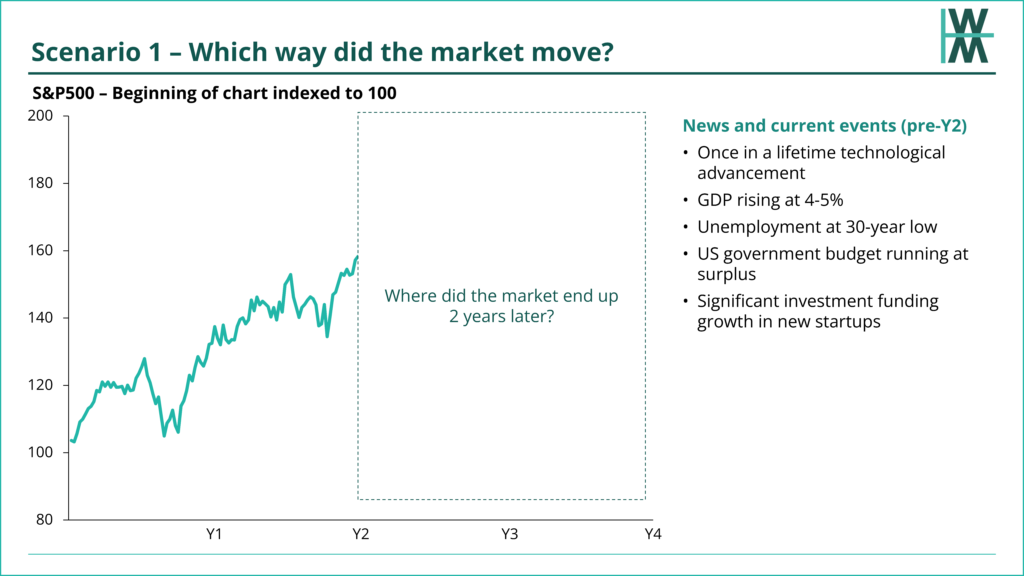
What did you guess? See below for what happened next:
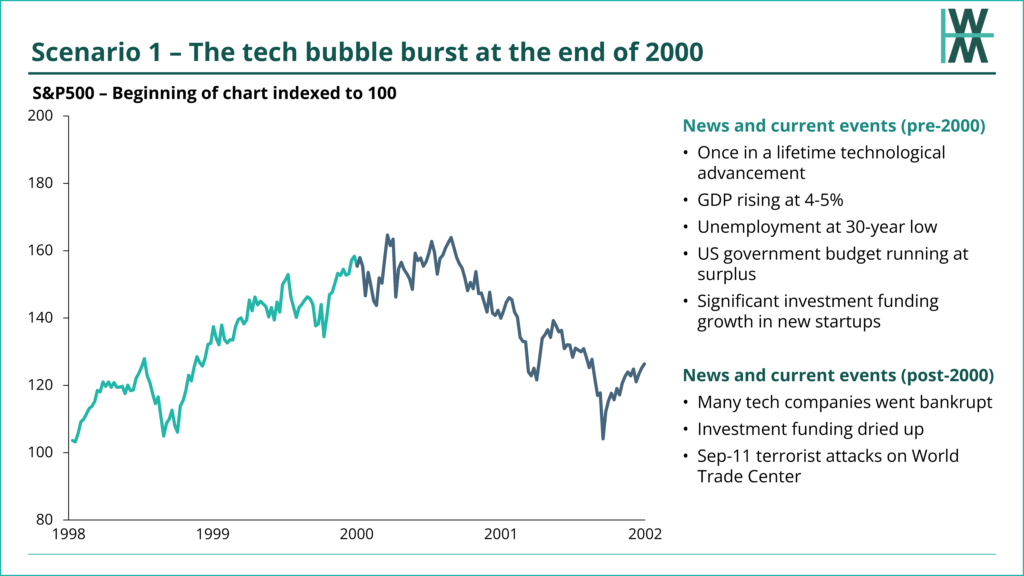
You wouldn’t want to look at the Nasdaq Composite Index, which fared much worse.
How about Scenario 2?
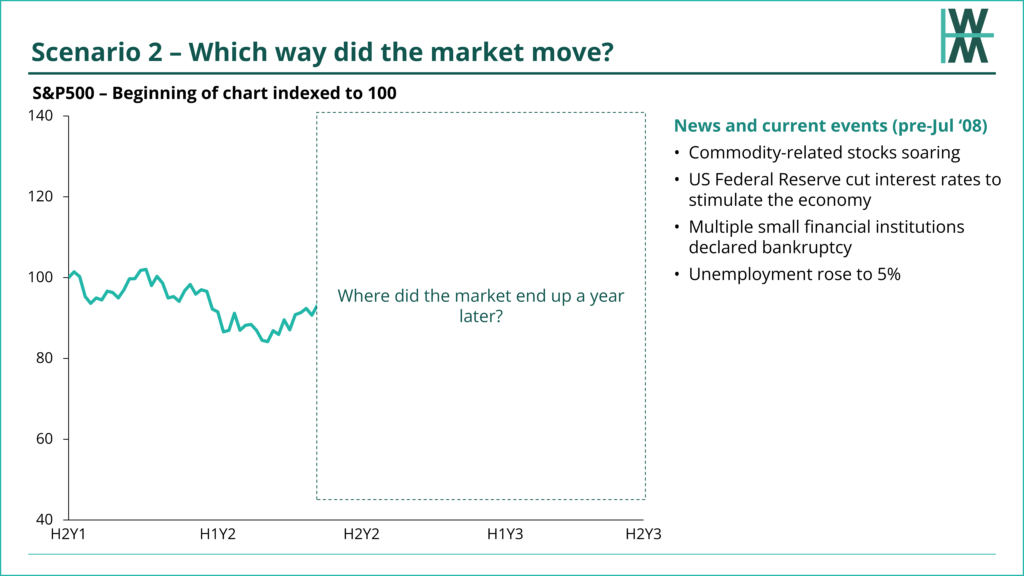
What do you think? Check below:
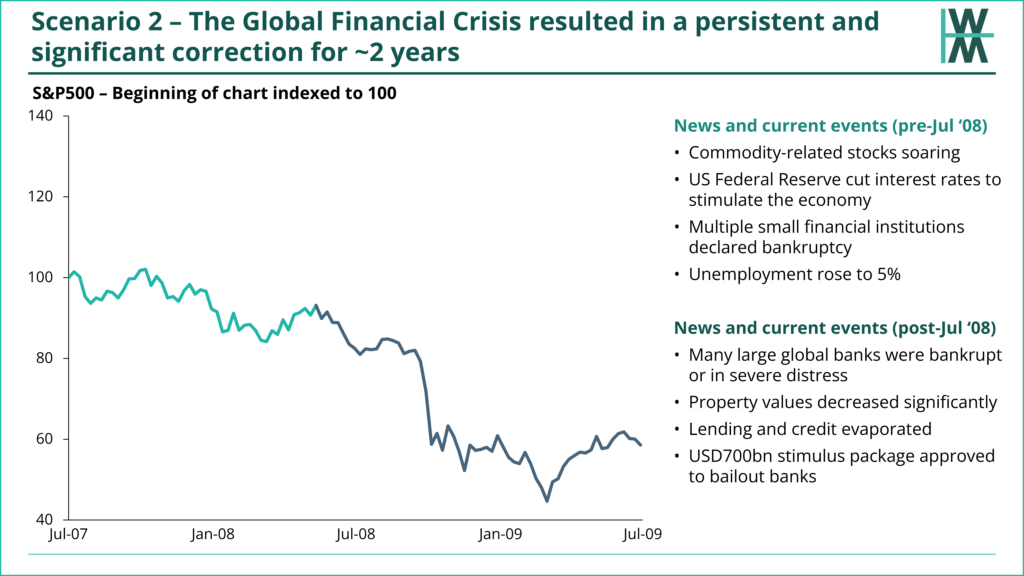
If you’re as old as I am and lived through the GFC, you would remember that everyone expected 2008 to be the bottom, and when the market kept declining, everyone thought that the world was ending and “this time it’s different”.
Okay, last scenario:
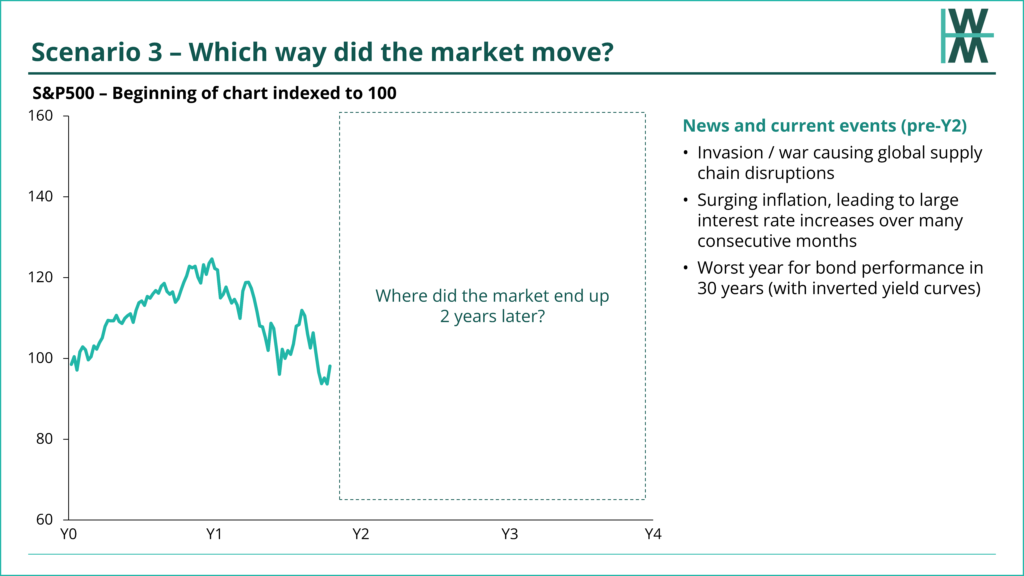
Last chance to guess. Here it goes:
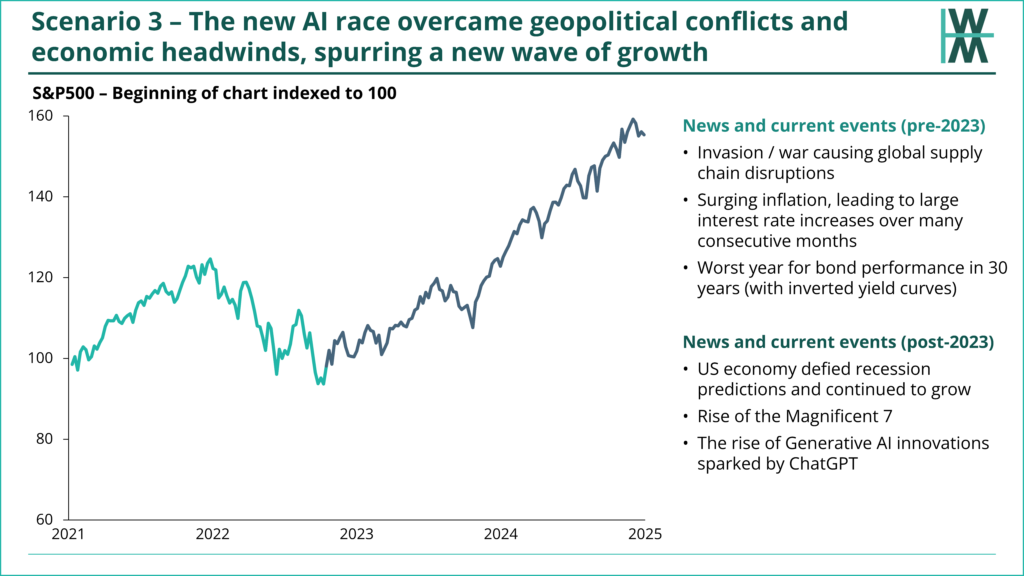
Despite all the negative sentiment, the most recent few years have seen an unprecedented bull run (which persists into 2026, despite new conflicts and oil supply issues).
How many did you guess right?
In hindsight, it might have seemed obvious, but when you’re deep in it, the reality is nobody knows. Nobody would have guessed the Global Financial Crisis could go even lower, but it continued to crash for another year, with many, many scary days where most thought the financial markets were over. In Scenario 3, no one would have predicted a market rally in the next two years with the war and steep inflation. But we’ve had some of the best S&P 500 performance in recent times.
What lessons can we derive from this?
- It is extremely difficult to predict how the market will move. That’s why, over time, most professional active investors do not beat the market. We’re so concerned about the war, tariffs, interest rates, China’s property bubble, AI stocks, and so on. But how much is paying attention to all these current events, data, and information helping your investment decisions?
- Most of the information/news you consume is meaningless. What you hear today becomes irrelevant tomorrow. Yet people are concerned about the short term and what shows up in their content feed about current events, making ever-changing, volatile personal finance decisions based on short-term sentiment.
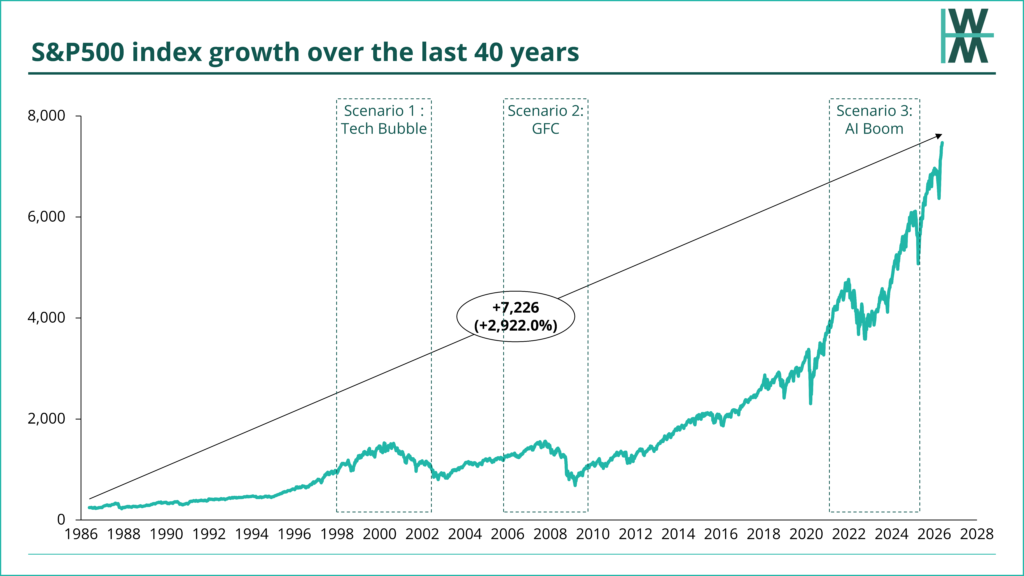
- As always, in the long term, the market will always go up. This is because fundamentally, all capitalist economies will always grow and innovate. Zooming out to take a 40-year investing perspective, even many of those significant market crashes appear to be “just noise”:
THE WORLD OF PERSONAL FINANCE (AND THE WORLD AT LARGE) IS BECOMING NOISIER
Here’s another reality check for you. Unlock your phone, go to your screen settings or digital health report section, which contains information on your screen time and app usage. Check:
- How many hours is your phone’s screen on daily?
- How many content-related apps are shown at the top of the list? (e.g., social media, news, YouTube, Kindle, web browser)
- How many hours a week do you spend on each content-related app?
Now think back to all the news, social media content and other information you’ve digested through your phone and other various sources, in the past 5 years.
How much of it is still relevant and useful information today?
Or is all that content you’re consuming just noise?
What about personal finance content? There’s an overabundance of content out there, all “free” and available on demand. At any given time, much of the information contradicts itself:
- Tracking expenses is the key to managing your budget. Writing down every expense is a waste of time
- Invest in ASB. Invest in EPF. Invest in crypto. Invest in gold. Invest in AI. Invest in Bonds. Invest in Futures. Invest in ETFs
- The market is a bubble that’s going to crash. The market is going to continue going upwards due to AI innovation
- The Ringgit is going to appreciate. The US dollar is going to crash. Interest rates are going up
- DCA every month. DCA every week. Invest using a lump sum
- Bank stocks give 7% dividends. REITs are paying 6% right now
- 50:30:20 budgeting. Pay yourself first. Debt is good. Take a 9-year car loan. Property always goes up
It is no wonder that thousands of people online ask random internet strangers daily questions like “I have XX amount of money, what should I do with it?”
What is true, and what is not? What is meaningful, and what is totally irrelevant?
How do you make sense of all that? What should you be doing with all this information?
MOST OF YOUR CONTENT CONSUMPTION IS LIKELY NOISE
The best starting assumption is that all content you’re currently consuming is noise. That’s because in 99% of instances, that would likely be true.
What are the definitions of signal and noise?
- Signals are information or data that is valuable and/or actionable
- Noise is meaningless, irrelevant or distracting data that impedes effective decision-making
Based on the definition above, think about the personal finance (and other) content that you consume daily. Is it really valuable and/or actionable data? If yes, what action did you take, or insight did you gain? Or is it just part of your mindless doomscroll? Especially if you’re a long-term investor with a simple and boring portfolio, be brutally honest with yourself.
Because the world is inundated with data. A lot more data than we actually need, especially in the world of personal finance.
But why and how did the world become so noisy?
AS COSTS OF CONTENT CREATION AND DISTRIBUTION REACH ZERO, THE NOISE TO SIGNAL RATIO INCREASES EXPONENTIALLY
The invention of the printing press and the radio ushered in the golden age of information distribution. The printing press allowed the mass production of books and newspapers, enabling the scaled reproduction of information. Radio (and TV) allowed for even greater scale, coupled with near-instantaneous distribution. However, both innovations were constrained by production costs and infrastructure, limiting scaled content creation to institutions of a certain size and maturity.
The Internet, however, was the catalyst for the current paradigm shift. Distribution and production costs have become cheaper and cheaper, until now, close to zero. As a result, access to information has become readily available and free to almost everyone.
This benefited humans immensely, but also resulted in an unintended second-order effect: an overload of noise. As the cost and distribution frictions dissipate, so does the quality of output. Anyone and everyone can create content without passing a required quality threshold, leading to… noise.
Lots of it.
And don’t forget, if something you’re consuming is free, you are the product.
AI is exponentially increasing this noise. The internet reduced cost and distribution friction. AI has reduced friction in content creation (though it is important not to equate capability to quality). Content slop was a thing before, AI slop just made slop production more accessible to all.
Although technology has evolved far more than we could have imagined, how our brains absorb, digest and leverage information has not.
THE WINNERS OF THE WORLD ARE BEST AT FILTERING OUT NOISE, AND ATTUNING THEIR ATTENTION TO SIGNALS
Above widely acknowledged personal finance skills, such as financial literacy, budgeting, investment/portfolio management, sits the meta skill of signal processing and noise reduction. The more you understand and hone your ability to filter noise and identify signals, the better your ability to make the right decisions.
Below are examples of how the best in the world of finance and investments have mastered the art of identifying signals and filtering out the noise.
Warren Buffett, generally considered the most successful investor of all time, is a master of separating signal from noise. He avoided the tech bubble burst and bought bank stocks after the Global Financial Crisis. His office does not have any Bloomberg terminals, TV or any other distractions. He refuses to invest in new trends or innovations which are outside of his “circle of competence”. He focuses on long-term investments in enduring businesses that he can ideally hold forever.
Nassim Taleb is a former derivatives trader turned author (The Black Swan and Antifragile) who has written about the noise bottleneck leading to a paradox: “The more data you consume, your ratio of noise to signal increases, leading you to know less, and the more inadvertent trouble you are likely to cause”. Also, as a remedy to the anxiety-prone “If I turn off all my news and social media, I will be uninformed”, he says, “the most significant signals have a way to reach you”.
Ray Dalio, the founder of Bridgewater Associates, the world’s largest hedge fund, built a “Principles”-based culture designed to systematically extract signals from economic data. He converts his principles into “algorithmic decision-making”, so his actions are only based on signals which his algorithm will pick up. This enables him to ignore noise effectively, such as to remove human emotion from the investment process.
Naval Ravikant is an entrepreneur and investor (and to me, one of the best modern-day philosophers) known for his “mental models”. He says to “read books, not news”, and speaks the truth when he says social media is not “social”, but a performative space for people to show off, built upon weaponised algorithms by skilled engineers to keep users addicted.
Side note: All of these amazing men have great content and writing. Go read them. You can get a tax relief on buying books, so no excuses. You may be asking what books Warren Buffett has written. He hasn’t. But he has ~50 years of excellent letters to shareholders.
WHEN YOU TUNE OUT NOISE AND LISTEN ONLY TO SIGNALS, YOU GAIN CLARITY AND FOCUS
There are a few ways in which better signal processing is immensely beneficial:
- When you tune out the noise, you expend less effort in filtering and trying to find meaningful knowledge and actionable insights
- A better honed noise filter ensures that you don’t mistake noise for signals, which leads to erroneous decision-making
- When you pay attention only to signals, you minimise distractions and are more likely to maintain consistent actions aligned to your Financial Plan.
What is considered noise differs from person to person, depending on your SMART goals. Generally, if you’re a long-term Boglehead investor, noise would be
- Any news or updates on stock market movements: Is it really going to matter in 5 years?
- Company earnings reports, analyst or social media commentary: You’ve invested in a simple and boring index fund portfolio, right?
- Stock tips and gossip from family and friends: Looking to make a quick buck?
- Interest rate changes or currency fluctuations: If a 5% drop in the Ringgit means you need to rethink your holiday plans or spending habits, you’re focusing on the trees instead of the forest
- Promotion of alternative asset classes: Itchy trigger fingers?
- Market crashes and recovery/expansion cycles: You should be operating from a position of strength, where you might be affected, but you can just stay the course and easily recover
What about examples of signals for the long-term Boglehead investor? Some examples are:
- Changes in taxation laws affecting potential tax liabilities (e.g., dividends, capital gains, etc.): Withdrawal and liquidity plans may be affected at retirement
- Significant change in investment fund structure resulting in significant underperformance (e.g., increase in management fees)
- Structural shifts in economies and global power balance (e.g., World War 2, China’s transition to capitalism): You might need to double-check your index fund portfolio breakdown (or better yet, just invest in a whole world index fund)
- Promotion at work, leading to a significant increase in income: More income means more options and flexibility
- Changes to personal or familial situation (marriage, divorce, kids): Large, underestimated money sinks
You’ll notice these signals occur infrequently. And that’s not a mistake. If you’re in it for the long haul, think long and hard about what the real signals are vs noise.
THE BEST WAY TO TUNE OUT THE NOISE IS TO BE VERY SELECTIVE AND RATIONALLY SCEPTICAL ABOUT EVERYTHING YOU CONSUME
This is the part where I tell you how you can tune out the noise and focus on signals.
Earlier in this post, I asked you to take a serious look at how much time you’re spending on your phone, and what apps and content you’re consuming.
The easiest way to tune out noise is to uninstall all social media apps (even Reddit, especially if you’re on r/wallstreetbets), stop reading the news, and replace them with deeper, long-form content. Books (both non-fiction and fiction), journals/articles, podcasts and documentaries are much more likely to be higher-value, signal-heavy content mediums.
Also, being extremely analytical to the point of being sceptical about the content you consume helps to minimise paying attention to noise. Think twice before you react to new information and ask yourself:
- Is this information accurate, and does it stand up to logical reasoning?
- Is this information relevant and aligned with my financial plan?
- Does the information change my circumstances such that I need to take action or make a decision to stay on the path to achieve my SMART goals?
CLOSING THOUGHTS
So the next time you see a headline saying something like “AI stocks down as investors run for cover“, or a content reel saying “I made 30% in gold in the past year“, take a pause and ask yourself, “Is that a signal, or is it noise?“
Also, it’s not just content. Your brain will process everything in your environment as either signals or noise. For example, consumers buy luxury goods to signal status and wealth to others. Is that just noise, masking large debt and relatively low income / net worth? Or do some wealthy people really spend on flashy, luxury goods? What does this mean in terms of your interactions and relationships with others? How does that affect your perception of the average person’s financial status and money psychology?
In the long run, honing your signal processing skills is highly attributable to another meta skill: Framing. Don’t know what Frame is? That’s the topic I’ll be writing about next: how you can radically transform your personal finances, career and overall life by defining and controlling your own frame.