Selecting funds that will significantly exceed market returns… is a loser’s game
John C. Bogle
KEY TAKEAWAYS
- A broad-based index fund mimics the performance of the index. However, contrary to popular interpretation, it is not a reflection of the average investor return in the market.
- Passive investing in broad-based index funds, over the long term, generates returns superior to those achievable by most active investment professionals
- Passive investing also outperforms actively investing in index funds (timing the market, waiting for the dip), or in individual stocks
- There is asymmetric upside vs the risks/costs when adopting a passive index fund investing strategy
INTRODUCTION
Not too long ago, I had a conversation with a younger ex-colleague who believed that he could ” beat the market”. As a Boglehead investor, I tried to convince him that a simple, boring portfolio is the best option for the retail investor. I explained that the odds are against him with active investing, using logical reasoning and facts.
Unfortunately, he thought he could get above-average returns. He also claimed I was “part of the system” that “dumb money” sought to disrupt.
That statement is not a rational argument to counter my facts. Counter the facts, not the character/person.
I’ve had many conversations with many young guns or new investors who think they’re the next Warren Buffett and can achieve above-average returns.
Albeit having 18+ years in financial services, of which 10 were spent in stockbroking, having survived the Global Financial Crisis, my attempts to save them from themselves fell on deaf ears.
It’s pretty ironic, because Warren Buffett himself said that the individual investor is better off investing in index funds.
I just remind myself that personal finance is driven by an individual’s psychology, biases and ego. It is rarely based on logic and facts.
Every new investor needs to learn from experiencing losses to gain the wisdom to grow wealth.
Everyone I spoke to who did not heed my warnings ended up losing money (or was not able to prove above-market returns). They all quit very quickly, within a few years.
Recently, I’ve been reflecting more on why, despite using rational facts and logic, many investors still believe they can outperform the market. I think I’ve figured it out.
MANY ASSUME PASSIVE INVESTING IN BROAD-BASED INDEX FUNDS MEANS AVERAGE RETURNS, WHICH IS FALSE
A common misconception by investors is that long-term investing in a broad-based index fund, say the S&P 500, will result in average performance and returns, as index funds mimic the performance of the underlying index.
I used to think this too. That I would get just average returns if I invested passively in index funds. I was actually comfortable with this, knowing in theory that most people don’t beat the market (which I also learnt by losing a few thousand dollars on my own individual stock investments).
But it sounds boring, right? Average returns. Why would anyone want average? No one wants to believe that they’re average; however, humans tend to have a bias to over-inflate self-assessments of their skills. It’s why ~80% of people believe they are above-average drivers, when the reality is that 80% of people can’t be above average.
Most people are average. Most “things” are average. That’s just by definition what average is.
So aside from the hubristic naivety of inexperience, perhaps the messaging and framing of passive investing in funds hasn’t been clear and aggressive enough amongst the Boglehead, FIRE and broader personal finance community. Many still consciously (or subconsciously) believe that passive index fund investing only delivers average returns. The problem is, everyone is looking to get above-average returns.
Well, if the subject of this post isn’t clear enough, let me reframe it into a direct and bold statement:
Passive investing in a broad-based index fund delivers superior long-term returns, with a far greater risk-return profile, when compared to active investing in individual stocks or even index funds.
In fact, passive index fund investing has been shown to outperform at least 80% of professional fund managers. By extension, this means you also likely would have outperformed more than 80% of all active individual investors (assuming that professional fund managers on aggregate provide equal or better returns than an individual investor)
The SPIVA Scorecard by S&P Global (yes, the one that created the S&P 500 index) has been tracking the performance of active fund managers and how many of them beat the index for which they benchmark their performance. They also account for funds that were liquidated or merged, ensuring there is no survivorship bias (fund managers are notorious for closing underperforming funds).
The data, as visualised below, is a pretty damming case against active investing.
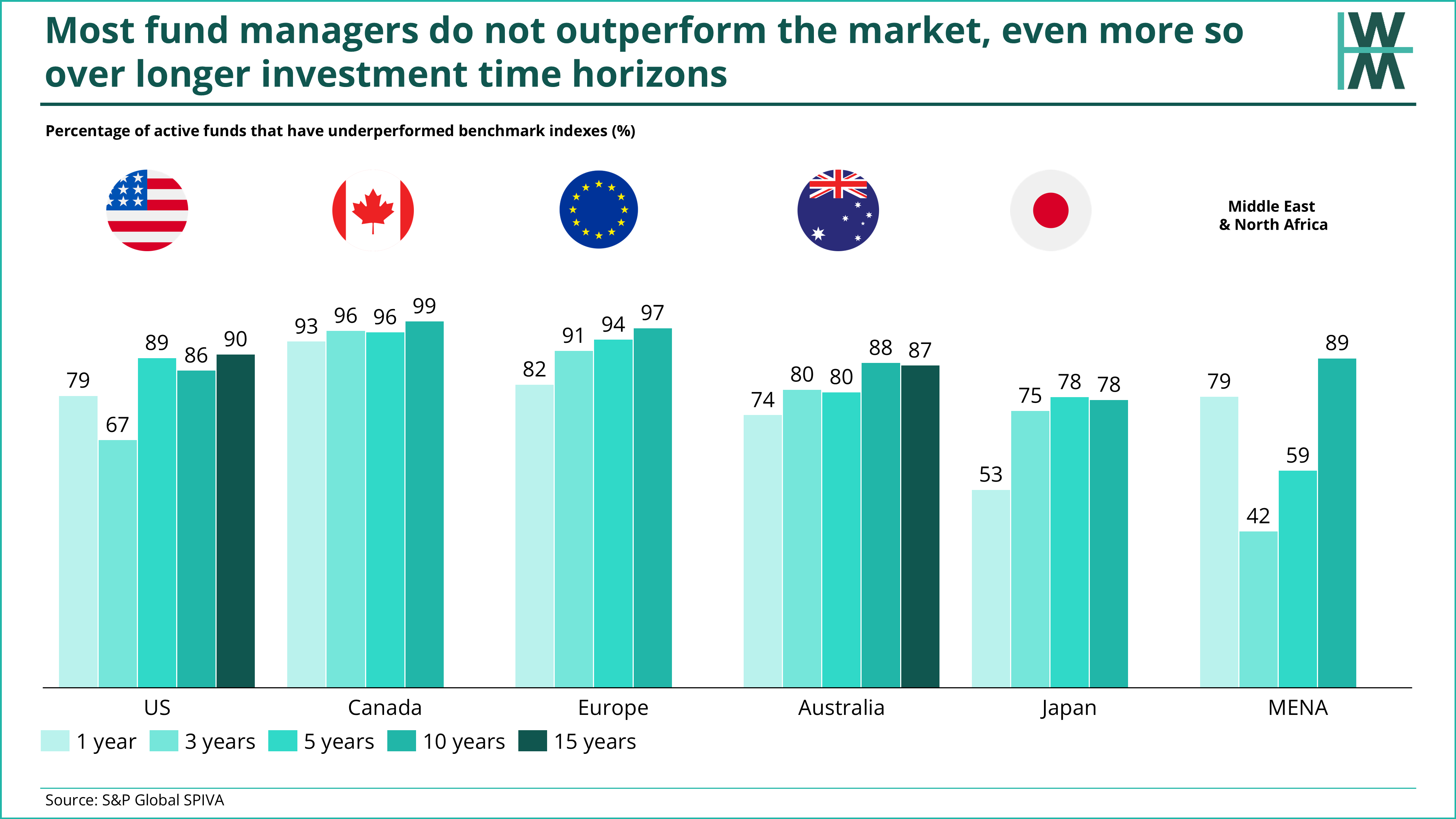
It’s pretty crazy that about 80% to 90% of active fund managers can’t beat the market, even in 1-year, 3-year, or 5-year time horizons. So, if you invest passively in broad-based index funds, your returns are better than 80% to 90% of professional active fund managers.
That likely means that when you invest passively via broad-based index funds, you will achieve superior returns, better than the large majority of investors in the market.
In other words, the long-term rate of return of broad-based index funds (say, the S&P 500) of 10% to 12% p.a. is actually better than 80% to 90% of investors in the market.
This concept may be confusing for some who assume that by mimicking market performance via index funds, you’ll get average returns.
Those who are confused might think that the movement of a market index is the average of all trades (and/or average returns) by all investors in the market. However, this is not true, as they are entirely different concepts.
The market index is not the average return of all investors making up the market. It is the weighted average valuation of all companies/stocks which are the constituents of that index. It is not (and does not correlate with) the average returns from each investor buying and selling shares in the market. This is an important distinction to make.
THE RETURNS OF ACTIVE FUND MANAGERS THAT OUTPERFORM THE MARKET ARE DISAPPOINTING, RELATIVE TO THE RISK AND PROBABILITY OF OUTPERFORMANCE
Now that we’ve reinforced the fact that passive index fund investing is superior to active investing, you might be wondering, “Well, what about the returns generated by the 10% to 20% that do beat the market? Their returns should be a lot higher than the market; else why would they bother?”
Well, several research papers have relevant data, as well as other reports and data points available online. I’ve pieced the various data points together to estimate the distribution of outperformance returns (alpha) for 30 years of investing.
What do you think the returns might be for these outperformers?
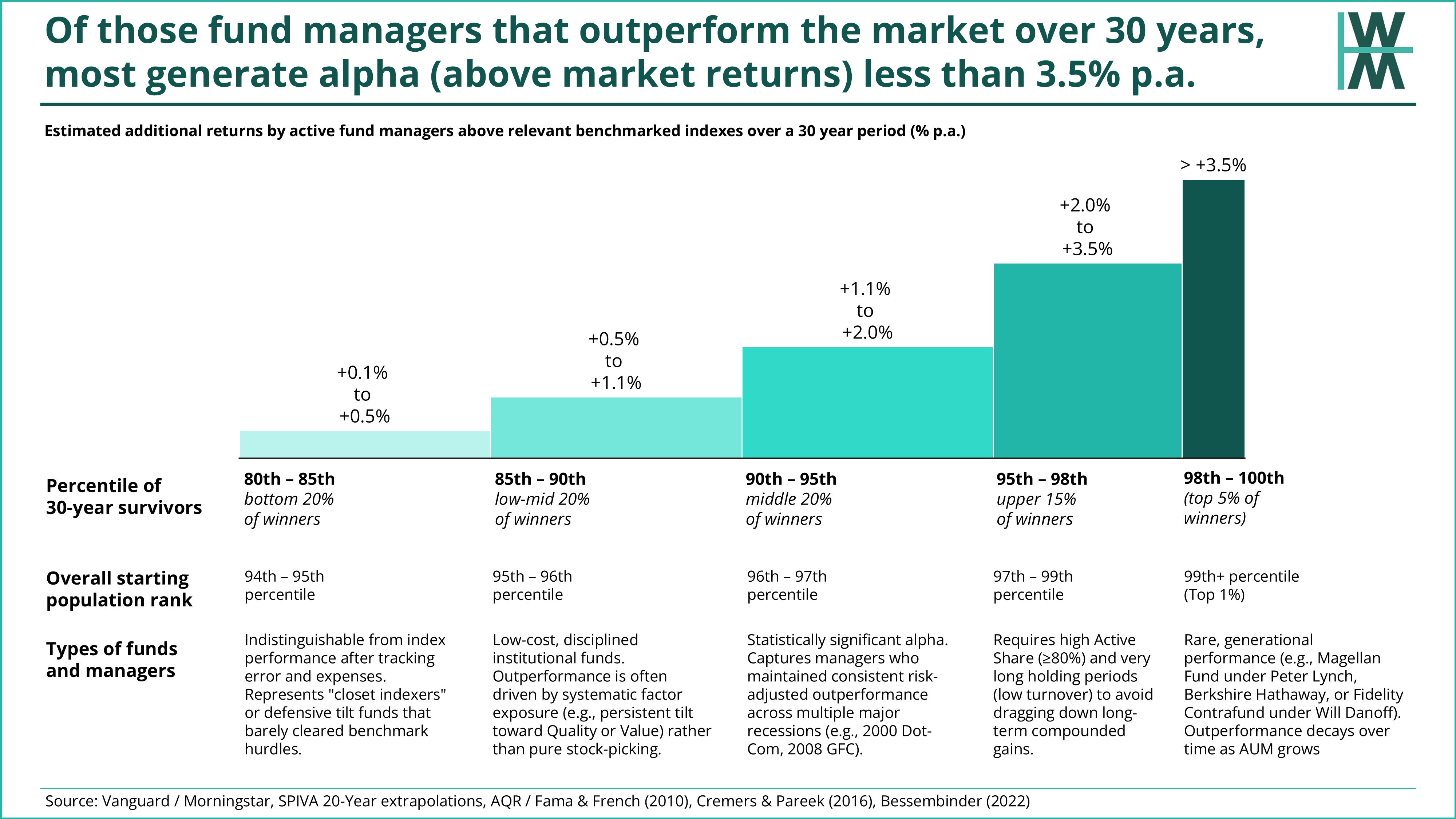
So from the chart above, the median outperformance is about 1% to 2% p.a. above the index benchmark. That means, of all investors who invested 30 years ago, the investment return performance needs to be in the 96th percentile to generate 1% to 2% p.a. alpha.
Let’s think about the probability of payout, or in the gambling world, betting odds vs the payout. For a coin toss, you should expect to play if you’re getting better than a 2x return for the right guess of heads or tails, as you have a 50% probability of guessing right.
So let’s see if the payout is worth playing to beat the odds. Let’s use the median outperformance scenario of 1% to 2% p.a. alpha:
- To achieve 2% p.a. alpha, you would need to be in the 96th percentile of investment performance
- Let’s say that the probability of achieving the 96th percentile is 4% (it’s actually lower, but for simplicity, let’s say it’s 4%)
- With a 4% chance of outperformance, you should expect at least a 25x payout to make it a worthwhile endeavour for the risk involved (1 / 4%)
If we invested RM10k over 30 years:
- A benchmark return of 10% p.a. (a conservative return) will result in a portfolio value of ~RM174k
- For an active investor, an alpha of 2% p.a. means 12% p.a. overall returns, which after 30 years will result in a portfolio value of ~RM300k
- That is a payout of 1.72x (RM300k / RM174k)
- However, I should expect a 25x payout (1 / 4%), which is a portfolio value of RM4.35m, or rather, a 22.5% p.a. return on investment over 30 years (to hit that RM4.35m portfolio value)
Hence, for a less than 4% probability of outperformance, the 1.72x payout for trying to beat the odds is extremely poor.
PASSIVE INDEX FUND INVESTING GIVES AN OUTSIZED PAYOUT IN YOUR FAVOUR, COMPARED TO THE ODDS
Now, looking at betting odds for passive investing, we can see there is an asymmetric payoff. For virtually no effort, skill or risk, you get superior returns of ~12% p.a., which is better than 80% of other investors who are actively investing or selecting individual stocks.
Also, the ~12% p.a. returns are virtually guaranteed; that is, I dare say, a near 100% probability of happening over 30 years. The data across the last 100+ years has proven this, and unless the fundamental concept of equities and index funds changes significantly (which has never occurred), it will continue to (almost) guarantee similar returns in the future.
Now obviously, you have to hold and not interfere with the investment over the 30 years, but that’s the whole point of passive investing.
In typical betting odds, a 100% certainty of outcome will likely pay 1x (1 to 1 odds). But in this instance, over 30 years, you get a 17x return (remember the example above, investing in RM10k results in ~RM174k over 30 years).
That’s a crazy payout, with guaranteed returns on investment.
CLOSING THOUGHTS
If you’re still a believer in active investing / individual stock selection being the better choice for you, ask yourself these three questions:
- Have you diligently tracked ALL investment losses and gains?
- Have you considered all the time, effort, and mental capacity to actively invest?
- After considering all that, are you achieving outsized alpha over 10, 15, 20 years?
Most active investors and traders love talking about their wins. But when I ask for evidence of outperformance over the long term, I have yet to see anyone produce credible evidence.
If you genuinely enjoy stock picking or active investing as a hobby, then sure.
But for anyone else who still hasn’t fully adopted passive index fund investing, what’s stopping you from switching over to get superior, above-average returns?